Archaea and Eukarya Share Which of the Following Features
Therefore the absence or presence of peptidoglycan is a distinguishing feature between the archaea and bacteria. Archaea and eukaryotes share metabolism associated with gene expression.

Biology Unit 1 Lecture 7 Study Guide Flashcards Quizlet
Have shown that Archaea and eukarya share unique enzymes involved in the synthesis of archaeal lipids that differ from the bacterial ones but that archaea also use a few archaea-specific enzymes required for the biosynthesis of archaeal membranes 18 22.

. Between Archaea and eukaryotes was further reinforced through stud- ies of the transcription machinery6 and the first archaeal genomes7 Genomic exploration of new TACK archaea revealing that many genes including the core of the genetic informa- While surveying microbial diversity in. These terms can be used interchangeably. Bacteria Archaea and Eukarya also called Eukaryotes.
However archaea and eukaryotes lack peptidoglycan. By contrast a two-domain. They have similar size and shape.
Transport of DNA from one cell to another through bacterial phage virus. An example of this group of organisms are bacteria the Archaea and Eukarya. Live in hot sulphur springs such as the sulphur springs in Yellowstone National Park.
Unlike the Bacteria and the Eukarya the Archaea have membranes composed of branched hydrocarbon chains many also containing rings within the hydrocarbon chains attached to glycerol by ether linkages. None of these domains is ancestral to each other and each has unique and distinguishable features and shared characteristics. DNA sequence comparisons and structural and biochemical comparisons consistently categorize all living organisms into 3 primary domains.
Archaea are metabolically diverse and able to utilize a wide variety of energy and carbon sources. In agreement with this view Lombard et al. Uptake of DNA from surrounding environment.
However because they do not have true membranes we dont know how they are constructed. Neither the cell walls of Eukaryota or Archaea are made of peptidoglycanwhich is what the cell walls of most bacteria are composed of. 25 rows Features Bacteria Eubacteria Archaea Archaebacteria Eukarya Eukaryotes 1.
Ether bonds are more resistant to chemical activity and allow archaea cells to survive in extreme environments that would kill other life forms. Bacteria Archaea and eukaryotes do not share the following treat. They are single-celled organisms that comprise cells with distinct properties that make them unique from the other two domains of.
Archaea and Bacteria do not possess membrane found organelles or nucleus. Yeah let us complete the following statement so that it is true. Sexual reproduction is common.
Archaea are prokaryotic cells. All cells have a phospholipid bilayer but in archaea cells the bilayer has ether bonds while the cells of bacteria and eukaryotes have ester bonds. Both can carry out asexual reproduction.
The evolutionary link of cellular complexity in eukaryotes. Eukaryotes also known as eukaryotes are live cell organisms with round ionettes for their membranes. Similar DNA replication machinery c.
03 Oct 2010 Leave a comment. Similarities between Archaea and Eukaryotes. Virtually all bacteria contain peptidoglycan in their cell walls.
In a three-domains tree of life part a Archaea and Eukarya each represent a monophyletic group and share a unique common ancestor to the exclusion of Bacteria 2 3. Both Bacteria and Archaea are prokaryotes single-celled microorganisms with no nuclei and Eukarya includes us and all other. - Archaea share the following characteristics with Eukarya select all that apply Select one or more.
In this page the domain Eukarya will be on focus. By Mega Kharisma in Uncategorized. Various types of cell walls exist in the archaea.
Translation and transcription that occurs in Archaea is similar to that that occurs in Eukaryota the one in bacteria is unique. In the diagram below the domains Prokarya Bacteria Archaea and Eukarya are illustrated and differentiated. Eukaryotic unicellular to multicellular organisms that have a membrane-bound nucleus containing several chromosomes.
Bacteria and Archaea are both Prokaryotes because their cells lack true nuclei. So let us go back now and complete our statement. Archaea domain Archaea any of a group of single-celled prokaryotic organisms that is organisms whose cells lack a defined nucleus that have distinct molecular characteristics separating them from bacteria the other more prominent group of prokaryotes as well as from eukaryotes organisms including plants and animals whose cells contain a defined nucleus.
The Archaea archaebacteria The Archaea possess the following characteristics. All living things can be classified into a place on the Tree of Life. Protein replication machinery d.
Bacteria Archaea and eukaryotes do not share the following treat. DNA replication in Archaea is similar to that. This phylogenetic tree has three major.
Archaea- heat and acid loving. Archaea Bacteria and Eukarya.
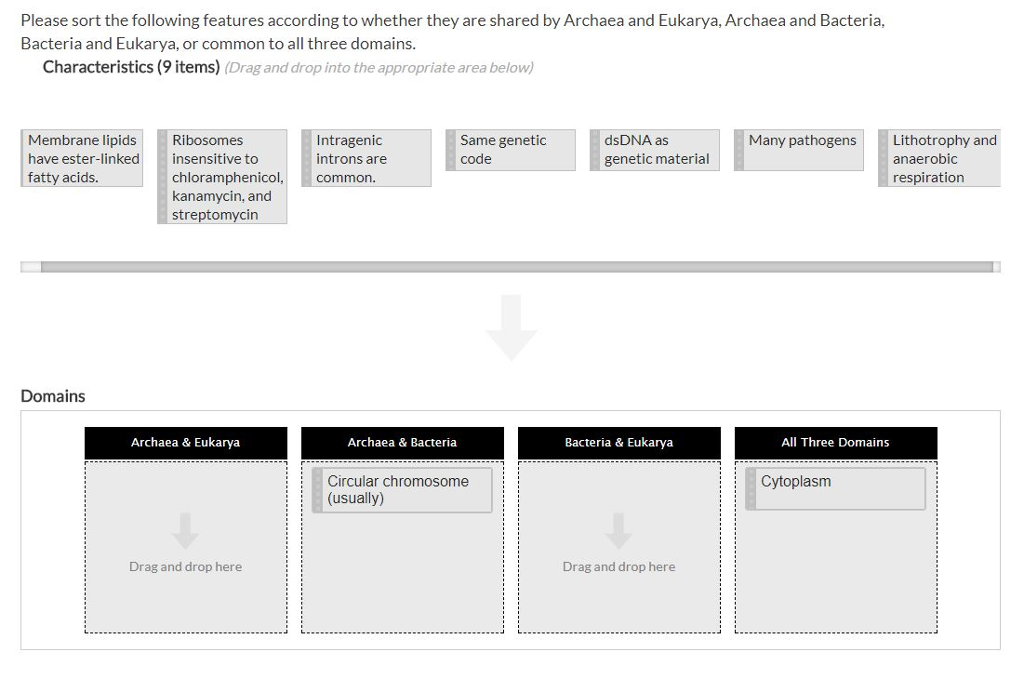
Solved Please Sort The Following Features According To Chegg Com

A Comparison Of A Few Traits Of Bacteria Archaea And Eukarya Download Table
A Comparison Of A Few Traits Of Bacteria Archaea And Eukarya Download Table


Comments
Post a Comment